• Skip to main content
  • Skip to primary sidebar
  • Skip to footer
  • All Posts
  • Contact

Time Restricted

Experiences with Time-Restricted Eating and Managing Chronic Disease

Posts

LDL-Patterns

December 25, 2018 By spao 100 Comments

Is Your LDL Pattern A or Pattern B?

Do you have high LDL or high total cholesterol?  If you read my previous article about cheese, you may recall that these LDL or total cholesterol numbers alone are not reliable predictors of mortality from heart disease.

An NBC News piece went further to cite American science writer Gary Taubes who reported that the LDL and total cholesterol numbers have been such poor predictors of disease risk that early screening tests should have likely just tested for HDL and triglycerides and nothing else.

A 1977 NIH study — an early set of papers from the now legendary Framingham Heart Study — confirmed that high HDL is associated with a reduced risk of heart disease. It also confirmed that LDL and “total cholesterol” tells us little about the risk of having a heart attack, language that heart-disease authorities would downplay years later. Given this finding, as Gary Taubes writes in “Good Calories, Bad Calories,” we would have been better off to start testing for HDL — or even triglycerides — and nothing else.

A more nuanced view associates the risk of atherosclerosis and heart disease with the type of LDL particles.  There are two patterns (also referred to as “phenotypes”) of LDL particles.

  • Pattern A: large, fluffy LDL particles which are largely benign
  • Pattern B: small, dense LDL particles which are more likely to oxidize and lodge themselves to arterial walls

Studies have long shown the impact of LDL particle size on disease risk. A 1988 study in the Journal of the American Medical Association documented the association between Pattern B (small, dense) particles and disease risk:

The LDL subclass pattern characterized by a preponderance of small, dense LDL particles was significantly associated with a threefold increased risk of myocardial infarction, independent of age, sex, and relative weight.

So why not test for LDL particle size?  The tests are more expensive!

However, there is an answer.  While testing for LDL particle size is more expensive today than commonly used cholesterol tests, a triglyceride / HDL ratio of 3.8 or higher can predict pattern B with high confidence.  A 1997 Harvard Medical School study also confirmed the efficacy of triglyceride / HDL ratio to predict the risk of myocardial infarction. 

Given the age of these studies, the use of HDL and triglycerides has become accepted practice in some circles, as described by Everyday Health.

According to Scott W. Shurmur, MD, the medical director of the cardiovascular center at Texas Tech University Health Sciences Center in Lubbock, Texas, the particle test should be used for people who have other risk factors for heart disease or stroke, such as a family history of heart disease at early ages. “At the same time, standard cholesterol tests like HDL and triglycerides provide similar information (and are less expensive), particularly if non-HDL cholesterol is incorporated into the assessment,” says Dr. Shurmur.

Unfortunately, there are no widely adopted standards today for metrics of triglyceride / HDL ratios in common clinical practice.  Some researchers have provided guidelines, including Zone Diet creator Dr. Barry Sears who wrote:

How can you tell which type of LDL you have? All you have to do is determine your ratio of triglycerides to HDL cholesterol, which would be found as part of the results of your last cholesterol screening. If you ratio is less than 2, you have predominantly large, fluffy LDL particles that are not going to do you much harm. If your ratio is greater than 4, you have a lot of small, dense LDL particles that can accelerate the development of atherosclerotic plaques – regardless of your total cholesterol levels.

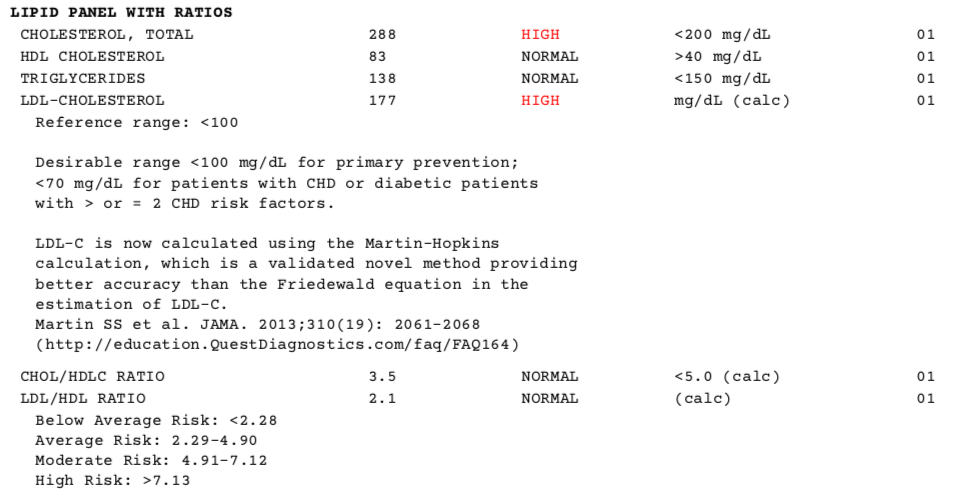
Still, patients who view their standard lab test results will notice that standard lab results list other ratios including Total Cholesterol / HDL and LDL / HDL ratios, but they do not list Triglyceride / HDL ratios. 
Cholesterol-Tests
High LDL and Total Cholesterol Readings with Normal Ratios
(TG/HDL = 138/83 = 1.7)

So why aren’t Triglyceride / HDL ratios more in use, or why aren’t LDL particle sizes discussed more often in the doctor’s office?  After all, most of the research cited in this blog article is decades old!

Frequent readers of this blog know my skepticism around a lot of Western Medicine.  Most continuing education for doctors is sponsored by pharmaceutical companies who have commercial interests in promoting use of lab numbers that their drugs can lower!  According to an academic paper titled “Statins Do Not Decrease Small, Dense Low-Density Lipoprotein:”

Our study suggests that statin therapy—whether or not recipients have coronary artery disease—does not decrease the proportion of small, dense LDL among total LDL particles, but in fact increases it, while predictably reducing total LDL cholesterol, absolute amounts of small, dense LDL, and absolute amounts of large, buoyant LDL.

In other words, drug companies likely suppress the information about LDL particle sizes because their drugs preferentially target the benign “Pattern A” particles over the more harmful “Pattern B” particles!

My opinion: Before going on cholesterol lowering drugs, take a look at your triglyceride / HDL ratio.  You may have “Pattern A” LDL particles and be at lower risk of heart disease than your LDL or total cholesterol numbers suggest.

Filed Under: Diabetes, Fasting, Featured

Sickness - viral or bacterial?

December 25, 2018 By spao Leave a Comment

Feed a Cold, Starve a Fever? It depends!

The old advice to “feed a cold, starve a fever” is a controversial one.  Given the controversy, I wanted to explore some of the differing opinions — the history, the conventional Western medicine view, and what the latest science suggests.

The Historical View

The old wives’ tale came from the belief that eating caused the body to “heat up” to mitigate the effects of a cold, and that fasting could help the body “cool down.”  On the surface, this hypothesis sounds logical, as eating does start digestion which does increase metabolism and generate heat.  Chemically, the process of digestion breaks chemical bonds, causing the release of heat.

That said, the body is a complex system, and more modern views dig a bit deeper.

Conventional Western Medicine

Western medicine has largely rejected traditional wisdom and dispensed the advice that eating through illness is always better.  A WebMD article jokes about the following:

Starve a Cold, Feed a Fever? If you’re not quite sure how this saying goes, you can relax: Starving is never the correct answer.

This rationale of the article is that many nutrients help fight infection, such as antioxidants, including beta carotene, vitamin C, and vitamin E, bioflavonoids, glutathione, and phytochemicals.

A Scientific American article concurs:

But recent medical science says the old saw is wrong.  It should be “feed a cold, feed a fever.”

The article also notes some additional points:

  • Supplements are “dubious at best.”  Studies show little or no benefit of taking vitamin C, zinc, or echinacea supplements alone in fighting illness.
  • “Even more crucial is drinking.”  The article points to the importance of fluids over food itself. Just make sure to avoid caffeine and alcohol!

The Latest Science: It Depends

A recent study by Yale researchers also shows the right answer may be even more nuanced.  Published in the September 2016 issue of Cell, the paper titled “Opposing Effects of Fasting Metabolism on Tissue Tolerance in Bacterial and Viral Inflammation” suggests that the advice of feeding versus fasting depends on whether the illness is viral or bacterial.

Graphical abstract of "Opposing Effects of Fasting Metabolism on Tissue Tolerance in Bacterial and Viral Inflammation"
Graphical abstract: Ketone bodies limit ROS-induced neuronal damage during bacterial inflammation. Glucose utilization prevents UPR-mediated neuronal damage during viral inflammation. Source: Cell, September 2016.

As suggested by the diagram above, further research showed that different areas of the brain were affected depending on the type of infection, and the body’s metabolic needs differed based on which part of the immune system was activated.

The researchers published a nice explainer video on YouTube.

What does this mean for us practically?  It’s not so simple.  Many diseases are both viral and bacterial.  So, the advice of the researchers is for us to listen to our bodies.  If we feel hungry or don’t feel like eating when sick, it may be our bodies’ way of telling us how to fight the infection appropriately!

Filed Under: Fasting

Cheese

November 18, 2018 By spao Leave a Comment

Is cheese the enemy?

Those of you who read this blog regularly already know that my answer would be “No!  Cheese is not the enemy!” At home, we’ve chosen largely an ovo-lacto vegetarian diet, which basically means we eat eggs and cheese.  But isn’t cheese the enemy?

Recent News

This topic hit my social media feed recently, so I thought I’d share my more detailed commentary!

The New York Times post covered the PURE study published in The Lancet analyzing data across 21 countries from 5 continents.  Whole-fat dairy consumption of three servings per day was associated with lower rates of cardiovascular disease and mortality, compared to lower levels of consumption.

Longer History

This is simply a reinforcement of what was known from the time before I was even diagnosed with diabetes.  The CARDIA study results published in 2002 actually showed an inverse relationship between dairy consumption and insulin resistance syndrome (IRS).

A later study in 2015 clarified that it is high-fat dairy that has the protective effects.  More surprisingly, high fat dairy uniquely reduces diabetes risk but meat intake actually increases diabetes risk!

Decreased T2D [Type 2 Diabetes] risk at high intake of high- but not of low-fat dairy products suggests that dairy fat partly could have contributed to previously observed protective associations between dairy intake and T2D. Meat intake was associated with increased risk independently of the fat content.

I never bought the arguments against cheese because it is high in fat, as numerous reports — including earlier results from the PURE study — have shown that dietary fat is not associated with either cardiovascular disease or mortality.  Also, I never bought the high cholesterol arguments against cheese, as high “bad” cholesterol levels appear to be unrelated to the risk of disease.  Despite what our doctors are telling us, most scientists are quick to point out that our bodies are much more complex than drain pipes and that arteries don’t get clogged simply because we eat foods higher in fat and cholesterol!

The more complex issue is about the high salt content in cheese.  I actually do agree with the assertion that most of us in the United States should reduce salt intake.  However, a study out of Penn State showed that the sodium levels in cheese do not affect the body the way the same sodium levels do in other salty foods.

Cheese and Gut Bacteria

I happen to believe that future studies will look further into the effects of cheese on our gut bacteria.  If you haven’t seen them yet, I recommend you read my posts on gut bacteria and diabetes and on gut bacteria and the metabolism of histidine.

Time wrote a very approachable piece about the potential benefits of cheese on the gut bacteria and the lower levels of the TMAO when metabolizing choline.  As referenced before in a previous post, there is an association between TMAO and Type 2 diabetes, so lowering TMAO may be an indication of a protective effect in the gut!

Science will ultimately catch up here.

The Environment

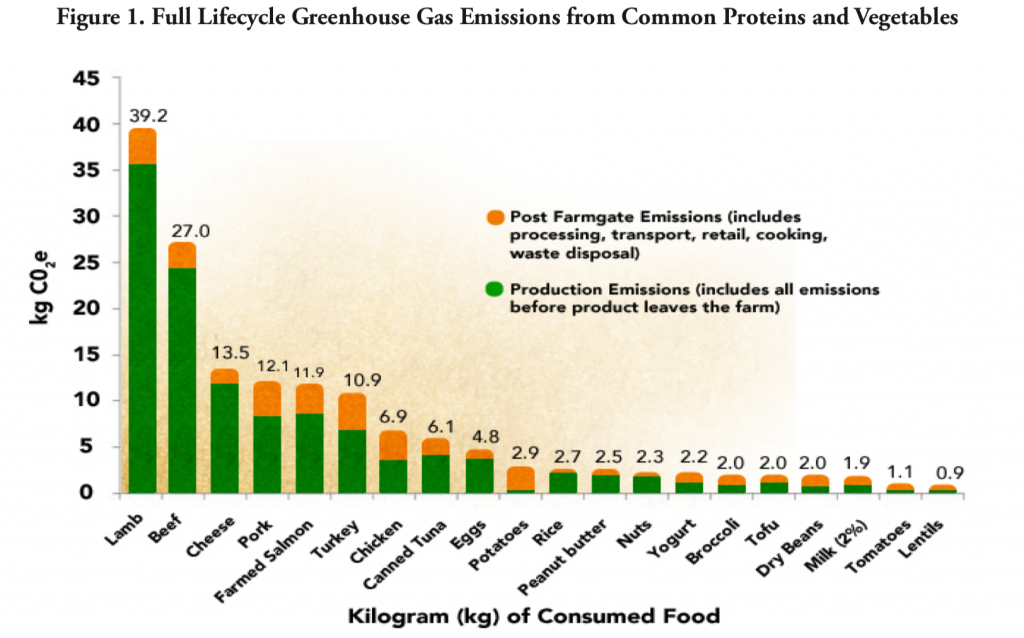
Until science does catch up, there’s another more point to make here.  Eating cheese does have an environmental impact.  Cheese ranks 3rd highest among common foods in greenhouse gas emissions on a per kilogram basis — higher than pork and chicken — largely because of the amount of milk it takes to make cheese.

Less dense cheeses and younger cheeses, such as cottage cheese, feta, brie, or camembert, don’t use as much milk and thus have a lower environmental impact.  It’s also important to note in most cultures, cheese is not eaten in large quantities.  It may be common in many cultures to eat a big piece of meat with a meal, but it’s not as common to eat a whole wheel of cheese at once!

For environmental reasons — independent of health considerations — try not to overindulge in cheese, and also be sure to eat what you buy!

Greenouse Gas Emissions from Proteins and Vegetables
Greenouse Gas Emissions from Proteins and Vegetables (Source: ewg.org)


Photo by Tabitha Mort from Pexels

Filed Under: Diabetes

Pregnant woman

November 11, 2018 By spao 5 Comments

Your mother’s nutrition and Type II Diabetes risk

Science continues to explain what we’ve known for a long time.  Mothers should eat in a healthy manner while pregnant!

This past week, a study out of Germany was published explaining how for some, the root cause of Type 2 Diabetes might be in the expression of a single gene, and that this gene can be “edited” early in life.  A Science Alert story covering this research explained the conclusion:

Intriguingly, researchers had found evidence that the binding protein’s gene had been silenced by an epigenetic switch – the DNA equivalent of a padlock that can be put in place for various reasons, typically environmental ones.

Their findings suggested that the gene for IGFBP-2 in the liver was edited early in life, setting the mice up for type 2 diabetes later.

The field is called epigenetics.  The Guardian wrote a very approachable piece on the topic.  In it they explain:

Studies of humans whose ancestors survived through periods of starvation in Sweden and the Netherlands suggest that the effects of famine on epigenetics and health can pass through at least three generations. Nutrient deprivation in a recent ancestor seems to prime the body for diabetes and cardiovascular problems, a response that may have evolved to mitigate the effects of any future famines in the same geographic area.

While most popular theories suggest that chronic diseases are caused by genetic factors and lifestyle, scientists now understand that environmental factors are also at play — and not just over long periods of time.  Your mother’s nutrition during pregnancy plays a big role in your adult health and risk of Type 2 diabetes and metabolic syndrome.

This theory started with Barker’s hypothesis of 1992.  The Oregon Health Sciences University (OHSU) summed up David Barker’s work well.

Over twenty-five years ago, he [David Barker] was the first to show that people who had low birth weight are at greater risk of developing coronary heart disease and diabetes – now a widely accepted fact. This finding led to a new understanding that chronic adult diseases are “programmed” in the womb by malnutrition and other harmful influences.

A decade later, the World Health Organization published a piece called “Programming of chronic disease by impaired fetal nutrition: Evidence and implications for policy and intervention strategies” calling for further research.  The New Yorker also wrote a much more approachable piece called 2007 called “Small and Thin” about this topic, which was still considered controversial even by 2007.

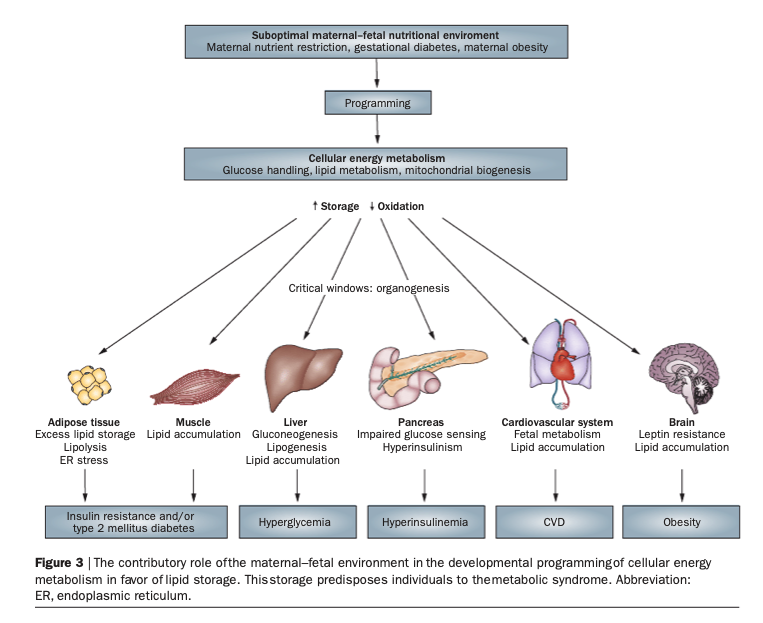
Still, scientific evidence on the impact of epigenetics continues to mount.  A literature review of the research was just done in August 2018 called “Nutritional programming of the metabolic syndrome.”  In it, they draw an interesting diagram of epigenetic effects of “sub-optimal maternal fed nutritional environments.”  (Don’t you love scientists?  😇)

Epigenetic impact of maternal nutrition
Source: Symonds, Michael & Sebert, Sylvain & Hyatt, Melanie & Budge, Helen. (2009). Nutritional programming of the metabolic syndrome. Nature reviews. Endocrinology. 5. 604-10. 10.1038/nrendo.2009.195.

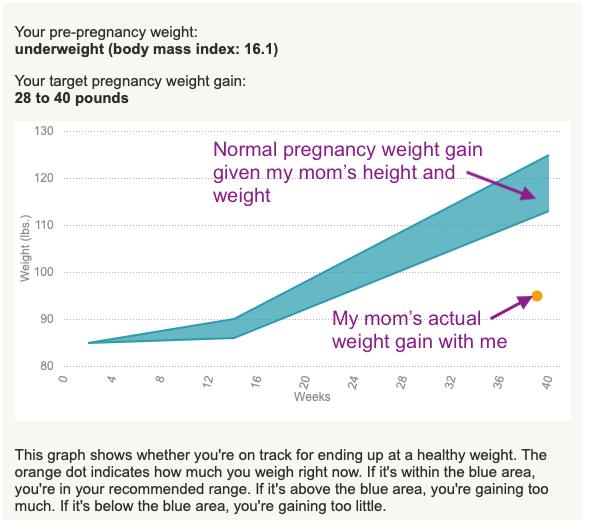
I personally became very interested in this topic back when I found out I had diabetes back in 2003, as I believe that I was personally impacted by epigenetics.  While I am not from an impoverished region, my mom — who is known among friends and family to always look her best — only gained 10 pounds when she was pregnant with me.  She had boasted to me once that no one even knew she is pregnant until she was 8 months in!  The graph below shows that, even for her, she was grossly underweight.

My mom's pregnancy weight gain
My mom’s pregnancy weight gain was well below what is recommended today

Source: babycenter.com

To sum it up, I think her dieting during pregnancy may have epigenetically impacted my gene for IGBF-2!  Of course, there’s a lot we didn’t know back then, and knowing this now doesn’t help me much personally for now.  I will still continue my own care as I have been!

Still, for any of you out there who are pregnant or know someone who is, make sure they know to eat well during pregnancy!


Photo by Leah Kelley from Pexels

Filed Under: Diabetes

Plant-based diets associated with better diabetes outcomes

November 3, 2018 By spao Leave a Comment

Are plant-based diets the answer for diabetes? Perhaps! But why?

Another study was published this week associating plant-based diets with better outcomes for diabetics.

The conclusion:

Plant-based diets were associated with significant improvement in emotional well-being, physical well-being, depression, quality of life, general health, HbA1c levels, weight, total cholesterol and low-density lipoprotein cholesterol, compared with several diabetic associations’ official guidelines and other comparator diets. Plant-based diets can significantly improve psychological health, quality of life, HbA1c levels and weight and therefore the management of diabetes.

This study was a meta-analysis of other studies, and didn’t attempt to draw a root cause.  The timing of the study’s publication fell close to World Vegan Day on November 1st.  Personally, I actually believe in variations of plant-based diets, such as ovo-lacto vegetarian diets (milk and eggs OK) because ovo-lacto vegetarian diets allow people to naturally get everything they need from food.

I’m more skeptical of vegan diets for most just because the rules aren’t as simple in the modern world.  Anyone thinking about a vegan diet should remember that vegans must also take supplements. Even those who claim that gorillas are naturally vegan without thinking about it have to remember that they supplement naturally by not washing their food.  They do end up eating some soil for minerals they don’t get from plants, as well as insects for key nutrients.

Still, I believe in getting most protein from plants.  There is certainly the sustainability angle to plant-based diets.  The Guardian wrote a very good piece titled “Avoiding meat and dairy is ‘single biggest way’ to reduce your impact on Earth.”

However, if you’re new to this blog, I also recommend you dive into my other posts on the reasons why the right plant-based diets can improve diabetes.

  • Gut bacteria.  Non-processed plant-based foods contain prebiotics (fiber) and have a positive effect on the composition and the activity of the gut microbiome.  There is a strong association between the dysbiosis – imbalance in the gut microbiome – and metabolic diseases, such as diabetes.
  • Mitochondrial function.  Plant-based foods are rich in many of the micronutrients missing from meat-based diets that are necessary for proper function of the mitochondria, i.e., converting macronutrients into chemical energy in the body.  Mitochondrial dysfunction is also strongly associated with metabolic diseases, such as diabetes.  Again, the key here is that mitochondrial function is optimal on balanced diets, and ovo-lacto vegetarianism involves fewer supplementation rules to keep track of than being vegan.

Again, I think the recent study has some merit and shares good data.  I’d just like to emphasize the “why” which I believe are tied to gut bacteria and our own mitochondrial function as the host.  Still, for myself (other than a recent bone broth fast), I’ve switched to mainly an ovo-lacto vegetarian diet, with an occasional “splurge” for meat or fish.

Filed Under: Diabetes

Gut bacteria in diabetics metabolizes histidine differently

November 3, 2018 By spao Leave a Comment

New study adds to story on gut bacteria and diabetes

This past week, a new study was published in the November 1 issue of Cell further investigating a role of gut bacteria and amino acid metabolism and its role in impairing insulin sensitivity.  The particular branch-chained amino acid (BCAA) under study was histidine, and how the gut bacteria process it differently in diabetic versus non-diabetic individuals.

In diabetics, gut bacteria process histidine into a specific metabolite called imidazole propionate at much higher concentrations, and this metabolite is believed to impair insulin signaling.  Here’s a picture from the study that describes the mechanism:

Graphical abstract from Cell VOLUME 175, ISSUE 4, P947-961.E17, NOVEMBER 01, 2018
How histidine metabolizes and impairs glucose metabolism in diabetics

To me, what is really significant about this study is the linkage to the gut bacteria.

In the past, doctors and scientists used to blame high protein and red meat for reducing insulin sensitivity.  After all, high histidine foods include beef, lamb, cheese, pork, chicken and other high protein foods. Some examples of studies linking high protein diets to insulin resistance include:

  • A 2009 study out of Duke expanded upon this hypothesis that high levels of protein coupled with high levels of fat (“the Western diet”) led to reductions in insulin sensitivity in animal studies.
  • A 2016 study out of New Zealand also took a closer look at high protein / high fiber diets and their effect on insulin sensitivity, taking fat out of the equation.  Taking into account weight loss differences, the study observed reduction in insulin sensitivity in obese study participants with high protein, compared to high carbohydrate, low fat diets.
  • A study published in the June issue of the Journal of Hepatology drew an association of insulin resistance with consumption of red meat and high heat cooking methods.  Here is its “lay summary:”

High red and processed meat consumption is related to several diseases. In addition, cooking meat at high temperatures for a long duration forms heterocyclic amines, which have harmful health effects. Non-alcoholic fatty liver disease is a significant public health burden and its formation is strongly related to insulin resistance. In this study, both were found to be more frequent in people who consume relatively high quantities of red and processed meat. In addition, a high intake of heterocyclic amines was associated with insulin resistance.

The natural reaction many reading these studies (which I think are valid, by the way) would be to figure out how to reduce protein intake to improve insulin sensitivity.  Even with this latest study, if histidine causes increased production of a harmful metabolite in diabetics, why not reduce histidine intake by reducing protein intake?  Not so fast.

I personally believe that this most recent study about the gut bacteria metabolizing histidine differently in diabetics from non-diabetics helps fill in a missing gap.  All around us there are exceptions to people who live on high protein / high meat diets that do not have diabetes or heart disease.  Just google “Inuit paradox” or “French paradox” and you’ll get lots of hypotheses why this may be the case, ranging from the types of fats in seals and walruses to drinking wine.  All of this may be valid, but there is a lack of discussion about gut bacteria.

If you haven’t already, see my previous blog post about gut bacteria and Type II diabetes.  The association between dysbiosis (an imbalance in the gut bacteria) and diabetes has been shown to be strong, and there are numerous studies demonstrating that fasting can positively affect the gut microbiome.

Personally, I believe that repairing the gut microbiome, returning the histidine metabolism of diabetics to be more like non-diabetics, may be a more promising step toward addressing the root causes of insulin resistance, rather than simply trying to reducing protein intake without fixing the underlying problem.


Beef icon made by Freepik from www.flaticon.com is licensed by CC 3.0 BY

Filed Under: Diabetes, Fasting

  • « Go to Previous Page
  • Page 1
  • Page 2
  • Page 3
  • Page 4
  • Page 5
  • Interim pages omitted …
  • Page 8
  • Go to Next Page »

Primary Sidebar

Recent Posts

  • Sharing the Good & Bad of Ozempic on Medium
  • Why I stopped taking Vitamin B supplements
  • What changes when you progress from chronic kidney disease stage 3B to stage 4?
  • Ozempic treats diabetes (but I didn’t lose weight!)
  • Glucose might not be the cause of Type 2 Diabetes

Archives

  • February 2025
  • December 2024
  • August 2024
  • November 2019
  • October 2019
  • June 2019
  • May 2019
  • December 2018
  • November 2018
  • September 2018
  • August 2018

Categories

  • Buchinger-Wilhelmi
  • Buchinger-Wilhelmi 2019
  • Chronic Kidney Disease
  • Diabetes
  • Fasting
  • Featured

Sign up for updates to Time-Restricted

Footer

Stephen Pao is the author of the Time-Restricted blog. Following a Type II diabetes diagnosis in 2003, Steve began experimenting with alternative approaches to managing the disease, including prolonged fasting as a complement to a low-carb lifestyle. Several years ago, Steve also added a more involved drug program, including Ozempic and Jardiance. By day, Steve is a consultant and board advisor to early stage technology companies. Steve and his wife are empty nesters, with two adult daughters.

Copyright © 2025 · Workstation Pro On Genesis Framework · WordPress · Log in