• Skip to main content
  • Skip to primary sidebar
  • Skip to footer
  • All Posts
  • Contact

Time Restricted

Experiences with Time-Restricted Eating and Managing Chronic Disease

Posts

Park VIlla at Buchinger-Wilhelmi Clinic

August 22, 2018 By spao 1 Comment

Our home for the next 28 days!

The adventure begins!  Today was “arrival day” at Buchinger-Wilhelmi.

Overall, the 100 years of experience here shows in their execution.  The staff here is well-versed at dealing with travelers from abroad.  Once arriving in Zurich, I was welcomed with a friendly phone call from a fluent English speaker who told us where our driver was waiting.  We were driven in a Mercedes E-class sedan to the clinic, where we were then greeted by name, escorted to our rooms, and given a brief introduction to the set of materials we were to then receive, including handouts, newsletters, books, and an iPad with a proprietary “fasting coach” app featuring their own video content!  There’s a lot of homework involved here in fasting!

I am going to apologize in advance for not taking as many photos as I’d like to here.  The clinic has a rule against use of mobile phones outside of our rooms, and we signed a little contract agreeing to these terms!  They do provide Wi-Fi in our rooms but discourage Web surfing, streaming media (outside their own!), and other distractions to keep us from being present in the moment of fasting.  That said, reading, writing, and other creative endeavors are encouraged during this time.

My wife and I have adjacent rooms in the Park Villa, overlooking the Bodensee.  The rooms are very sparse but clean.  Like a hospital, each room has nurse “call” buttons both at bedside and in the bathroom.  During the day, we have a nurse in our building, and after that, there is a night nurse on call.  (Update: at 4am Thursday morning while half asleep, I accidentally pressed the “call” button while looking for a light switch in the bathroom.  My phone rang immediately!  That really woke me up!)
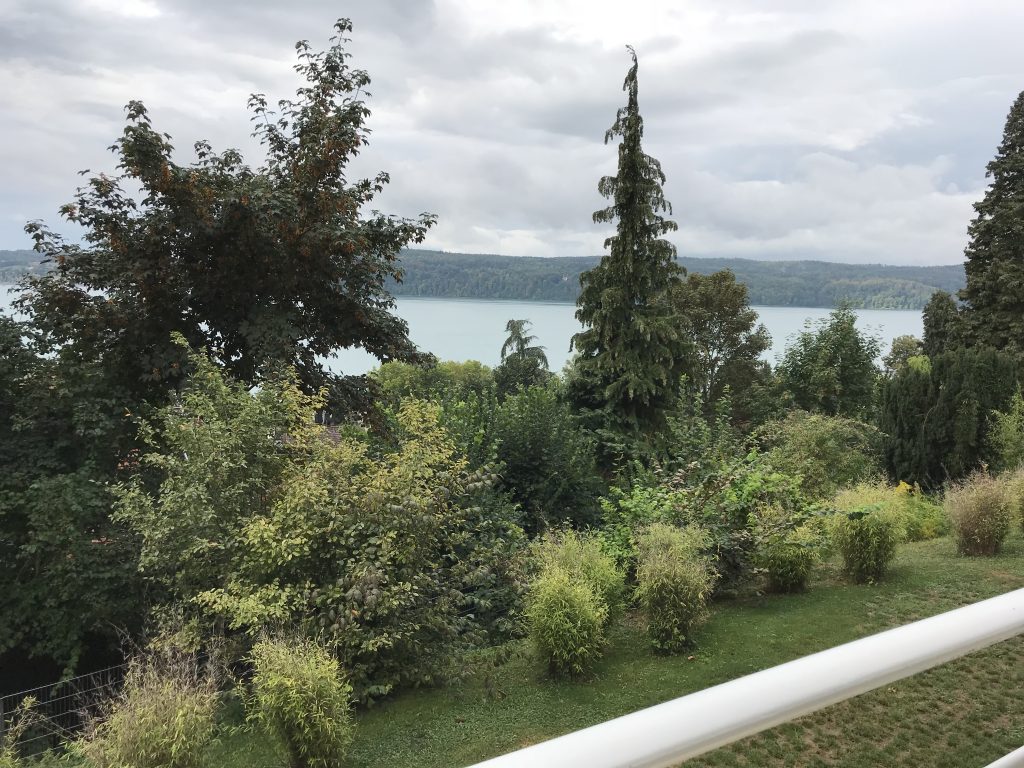
View Off Balcony at Park Villa (Buchinger Wilhelmi)
View from my balcony at the Park Villa

We also had our first appointments with our doctor, Dr. Lischke, who made a very good first impression!  I found it odd that the clinic specifies gender in their therapy schedules, as my handout referred to her as “Mrs. Dr. Lischke.”  Perhaps this is more appropriate for a very international audience.
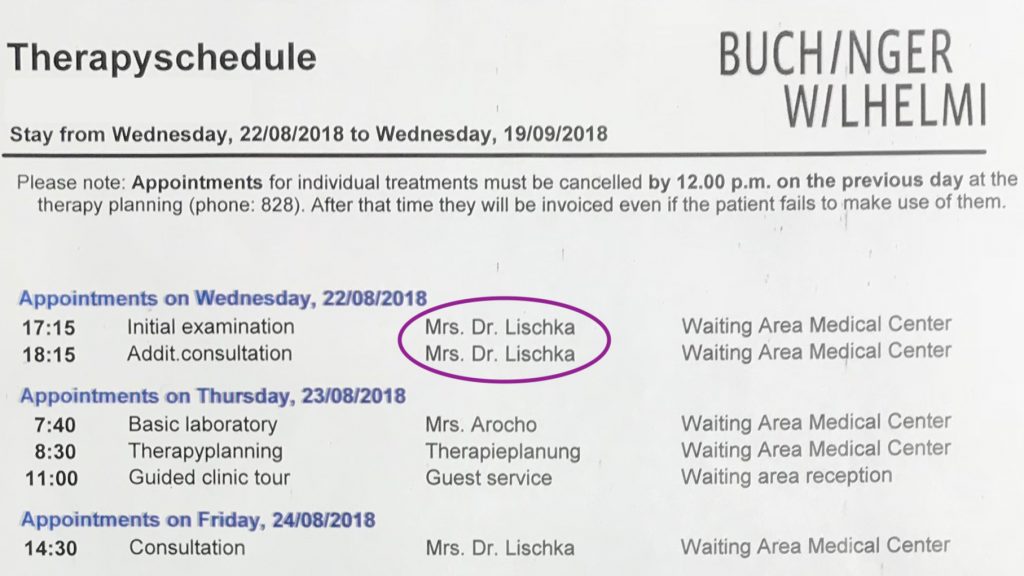
Therapy Schedule for Buchinger Wilhelmi
Therapy Schedule – note the “Mrs. Dr.” designation!

For our first day here, we got to eat full vegetarian meals for both lunch and dinner.  The food here is excellent!  To me, it’s ironic that a fasting retreat has gourmet cuisine, but the doctrine here is as much about having a healthy lifestyle after the clinic to fully realize the benefits of fasting!  In addition, we were told that the first day of food is really to ensure that, after the weariness of travel, we’d have full strength to begin the process of fasting.

In the dining room, we have assigned seating.  We were situated at a table for four people, but we did not see the other two people at our table today.  Perhaps they are already fasting! Still, there were many people there either before their fasts, after their fasts, or, in some cases, enjoying the “calorie restriction” program here as an alternative to fasting.

On the way to the dining room, we pass the “salon” where the people who are fasting congregate during mealtimes to consume their vegetable broths.  I’ll be documenting what that’s like in a couple days!  Our first day of fasting will be Friday!

Tomorrow, we’ll be our “digestive rest day.”

Filed Under: Buchinger-Wilhelmi, Fasting

Seatac Airport 2018-08-21

August 21, 2018 By spao 2 Comments

Leaving for Buchinger-Wilhelmi fasting retreat today!

Today is the day that my wife and I are leaving for a 28-day fasting program at Buchinger-Wilhelmi to (hopefully!) reverse my Type II diabetes.  We booked this trip back in April, and since then many people have asked me to chronicle our experiences.  As such, I started this blog, and I’m announcing it today!

I encourage you to go back and read the articles on this blog leading up to this one.  Before just journaling about the retreat itself, I wanted to provide some context to why I’m on this journey, and I encourage you to share the blog with others who may be diagnosed with Type II diabetes or prediabetes and looking to reverse it.

To stay up to date on posts, you can either follow my Time-Restricted Facebook page (you don’t need to be “friends” with me) or sign up for the time-restricted email list (again, separate from the now decades-old Pao Family Holiday spam list so that diabetes sufferers don’t have to hear about how our kids are doing!)

A Tale of Two Rooms

All that said, I wanted to start by thanking my wife for volunteering to come and fast with me.  She doesn’t suffer from diabetes and is really coming for moral support.  Already, that moral support is working, as I don’t feel “anxious” or “stressed” about the month ahead.  She’s going to be with me, as she’s been throughout this journey.

One of the more humorous aspects is that we’ll actually be getting two rooms — actually to get two toilets!  One issue here is that when you fast, you don’t really poop on your own the way you do when you’re eating.  I’ve only gotten bits and pieces so far, but it appears that this clinic has their own ways to keep you “clean.”

Here’s what the reservation agent said in her email to me.

With one room together it depends on you. Many people want to book two separated rooms because you have to sit on the toilet after the glauber salt and you will every second day an enema.

We also can offer you two Superior rooms with connecting doors or an additional Comfort room, so every person has his own toilett [sic] and bed but the rooms are connected.

The difference in cost between Superior rooms and Comfort rooms was significant, and my Chinese genetics couldn’t justify that for an adjoining door.  We were going to hang out in one room anyway, and simply retreat to our respective toilets to poop.  Is an adjoining door in that case a feature?

After some back and forth, the reservation agent simply replied.

I understand your point of view. We can organise that both Comfort rooms will be next to each other .

$3.56 to wash my underpants?

The other funny story about this retreat is that it’s 28 days, and the laundry is expensive!  Some sample laundry (“Wäscherei”) prices:

  • boxer shorts – € 3.10 euros
  • socks – €3.00 euros
  • T-shirts – €4.30 euros

At the exchange rate of $1.15 per euro (€), this is like $3.56 per boxer short, $3.45 per pair of socks, and $4.95 per T-shirt!  Call me weird, but I just didn’t think that was at all worth it.  So, I procured extra stuff at Target and Costco (as well as a larger suitcase!) and packed 28 days of the “essentials.”

My original concern about packing so much was that I wouldn’t be able to fit everything.  The issue was not space but rather weight!  (The limit for the “free” baggage for international travel is 50 lbs.)

That whole scenario with being constrained by weight and not cooling reminded me of life in the data center business.  We often found that we were not constrained by rack space but rather power delivered to the rack, and the associated cooling!

Anyway, we ended up working around the checked luggage weight constraint by putting a bunch of stuff into our carry-on luggage.  My second thanks go out to my wife (who is 5’1″) for carrying some of my stuff through airports!


Filed Under: Buchinger-Wilhelmi

Buchinger-Wilhemi-View-oer-the-lake

August 17, 2018 By spao 1 Comment

About to head off to a fasting retreat!

My wife and I will be headed to Germany for a 28-day fasting retreat!  (She is along for moral support!)

People often ask “why so long?”

I’ll cover more about the “why” and “how” of fasting in future posts.  However, to net it out:

  • I have excess fat in my liver, like many other TOFI Asian Americans, which led to a diagnosis of Type II diabetes back in 2003.
  • I want to do prolonged fasting to “stress” my liver cells to “restart” fat absorption and to reverse the disease.
  • Without all the science fully understood, there has been a centuries-old tradition of fasting for health and well-being across many different cultures.

While I’ve done 36-hour fasts and 3-5 day fasts on my own before, I wanted to learn more from extended fasting under medical supervision.  There were three different options I considered:

  • Intensive Dietary Management, a distance coaching program founded by Dr. Jason Fung, a nephrologist who has authored very educational blog articles and books about fasting and diabetes treatment.  I’ll dedicate a post to Dr. Fung’s work in the future.
  • TrueNorth Health Center, a clinic in Santa Rosa, CA, founded by Dr. Alan Goldhamer, lead author of a 2001 paper “Medically supervised water-only fasting in the treatment of hypertension.”  TrueNorth was founded in 1984 and today treats people with Type II diabetes.
  • Buchinger-Wilhelmi, a clinic on Lake Constance, Germany with 100 years of clinical experience in therapeutic fasting.

All three choices sounded viable!  However, the Buchinger-Wilhelmi option felt the most “immersive” to me.  In addition to just fasting, the program combines:

  • therapeutic fasting
  • integrative medicine
  • psychotherapy and coaching
  • nutrition and dietetics
  • exercise and relaxation
  • inspiration and spirituality
  • beauty
  • daily activities (e.g., walking tours, workshops and courses, lectures, training courses, concerts and literary evenings)

The clinic is a fourth-generation family-run business and started after the founder, Otto Buchinger, started a 19-day fast in 1919 to cure his rheumatoid polyarthritis.  They have been treating patients with therapeutic fasting ever since!

Plus, look at these surroundings!

Buchinger-Wilhemi-View-oer-the-lake
View on the Lake from the Buchinger Wilhelmi Web site

We will be doing a 28-day program, which we believe will involve:

  • 4 days to ease into fasting
  • 20 days of fasting-mimicking diets
  • 4 days to ease off of fasting

We will also get medical checkups to ensure all is going well!

We’ve been asked by many to keep them up-to-date on what happens.  We’ll let you know on this blog.  Subscribe for updates!


Filed Under: Buchinger-Wilhelmi, Fasting

Fatty Liver

August 16, 2018 By spao 2 Comments

Diabetes and non-alcoholic fatty liver disease

In my last post, I discussed the “fat on the inside” of people with diabetes.  One of the most insidious places for this fat to live is in the liver!  Science is now showing the relationship between liver fat and diabetes, and the potential cure for both — fasting!

Diabetes and non-alcoholic fatty liver disease (NAFLD) are closely linked, with studies showing that NAFLD is present in up to 70% of patients with Type II diabetes.

While the association between diabetes and fatty liver disease is well known, the relationship between the two has been unclear in Western Medicine.  Which comes first – diabetes or NAFLD? A study of a Korean population published in 2011 sought to investigate this question and found that the presence of fat in the liver was a good predictor of Type II diabetes risk:

Nonetheless, fatty liver detectable by ultrasound identified individuals with worse metabolic profile and greater risk for T2DM [Type 2 diabetes mellitus], regardless of baseline fasting insulin concentration. Therefore, our findings suggest that fatty liver, although associated with insulin resistance, is also an independent predictor of T2DM.

A newer analysis of Chinese patients published in 2017 demonstrated a bidirectional relationship between fatty liver disease and diabetes.

In conclusion, the present prospective cohort study provides evidence that the association between NAFLD and T2DM is bidirectional. Future studies are needed to investigate the potential mechanisms.

The irony is that despite the growing evidence of a causal relationship between diabetes and NAFLD, the current treatments don’t really address fat accumulation in the liver!  Diabetes drugs use different mechanisms, such as getting your liver to produce less glucose, getting your pancreas to create more insulin, or even getting you to pee out sugar from your blood excreted through your kidneys.  However, they don’t address what appears to be a root cause.

To that end, a recent study out of Germany has identified a specific protein responsible for controlling the absorption of fatty acids in the liver and associated blood sugar levels!

Subsequent simulation tests showed that GADD45β is responsible for controlling the absorption of fatty acids in the liver. Mice who lacked the corresponding gene were more likely to develop fatty liver disease. However when the protein was restored, the fat content of the liver normalized and also sugar metabolism improved. The scientists were able to confirm the result also in humans: a low GADD45β level was accompanied by increased fat accumulation in the liver and an elevated blood sugar level.

How do you restore the protein levels to normal?  By stressing the liver cells through FASTING!

“The stress on the liver cells caused by fasting consequently appears to stimulate GADD45β production, which then adjusts the metabolism to the low food intake,” Herzig summarizes.

While the follow-on to this research is to find other ways to stimulate the protein production through drugs, the easier mechanism I see now is through fasting!

This is why I am taking my journey!

Filed Under: Diabetes, Fasting, Featured

Asian-TOFI

August 16, 2018 By spao 2 Comments

TOFI – Thin on the outside, Fat on the inside

When I was first diagnosed with diabetes in 2003, my doctors were puzzled.  While most of their patients were obese, I was a so-called “normal weight” (BMI < 25) patient.  How did I get diabetes at my BMI and and at my age (36 at the time…)?

Today, much of the mystery is solved.  I am a “TOFI” (think on the outside, fat on the inside) Asian-American.

The term TOFI was popularized in an article published in The Guardian describing how apparently “thin” people have hidden fat around the organs, which can lead to diabetes.

Tofis probably need to worry more about their health than others, because the fat deposits they carry are hidden in the white fat that lies around their vital organs, streaked through their underused muscles, and wrapped around the heart. It is this fat that sends out the chemical signals which eventually lead to insulin resistance, diabetes and heart conditions, rather than the fat lying in dimples underneath the skin.

While The Guardian article did cite genetics playing an “enormous role,” the data at the time was more anecdotal, with no specific mention of Asian-Americans.

The data came in 2012!

The CDC’s National Health and Nutrition Examination Survey (NHANES) data taken from 1998-2012 revealed that I was actually part of a larger group of TOFI Asian-Americans living with diabetes.  In 2015, the NIH issued a press release titled  “More than half of Asian Americans with diabetes are undiagnosed.”   In it, they wrote:

One difference between Asian Americans and the other groups studied, however, is that Asian Americans often develop type 2 diabetes at a lower body mass index (BMI). The NHANES data showed the average BMI for all Asian Americans surveyed was under 25.

Today, the CDC has a page “Diabetes and Asian Americans” devoted to this issue.

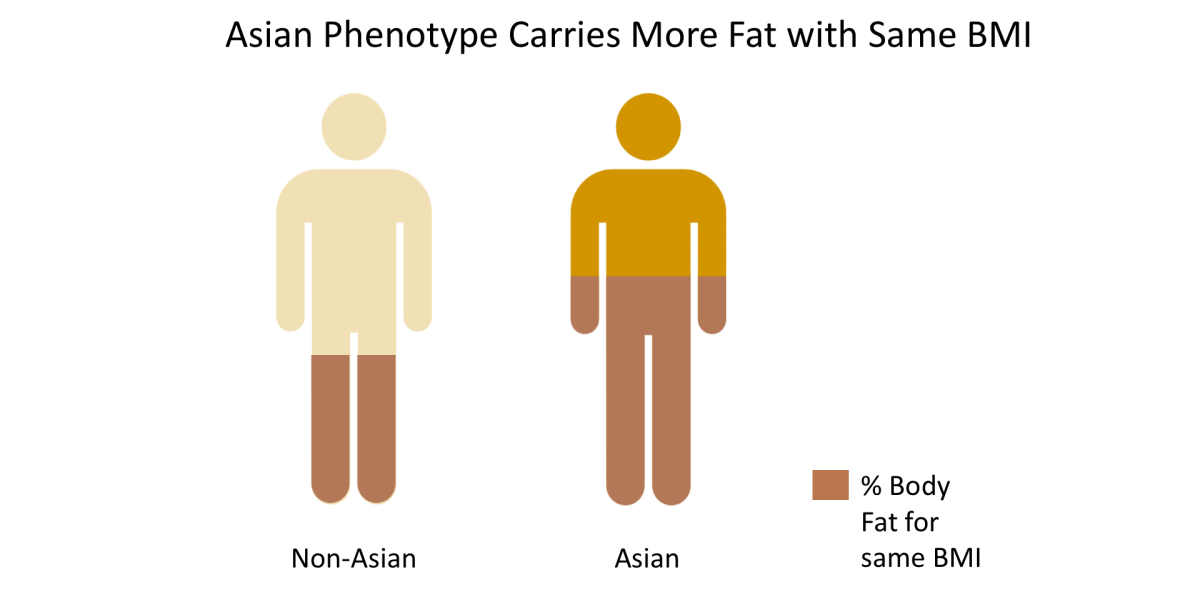
But people of Asian descent have less muscle and more fat than other groups and often develop diabetes at a younger age and lower weight. That extra body fat tends to be in the belly (visceral fat). This isn’t the “inch you can pinch,” the fat stored just under the skin. Visceral fat is out of sight, wrapped around organs deep in the body. You can’t tell how much visceral fat someone has by looking at them.

So, looks can be deceiving when it comes to Asian-Americans and diabetes!

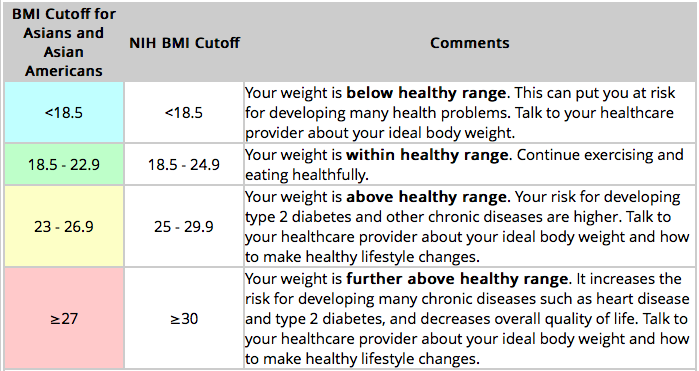
Affiliated with Harvard Medical School, the Joslin Diabetes Center has gone so far as to create a new BMI chart specific to Asians.

Asian-BMI-Chart-Joslin-AADI
Chart from the Joslin Diabetes Center – Asian American Diabetes Initiative

Note that while being Asian-American and TOFI is linked to diabetes, there is some broader work suggesting a distinct “Asian phenotype” be applied in medicine as a whole!

Factoring in Asian phenotypes is essential for the medical research community and the development of improved clinical practice guidelines across a continuum of disciplines that will ultimately translate to better human health round the world.

So, while the medical research community still has a ways to go, it is clear that we TOFI Asian-Americans need to take matters of Type 2 diabetes into our own hands!

Filed Under: Diabetes, Featured

Michael Mosley IGF-1 after a 3½ day fast

August 14, 2018 By spao Leave a Comment

Two videos to watch for diabetes care

For anyone interested in fasting and treatment of diabetes, I recommend two videos out of the UK.

Eat, Fast, and Live Longer

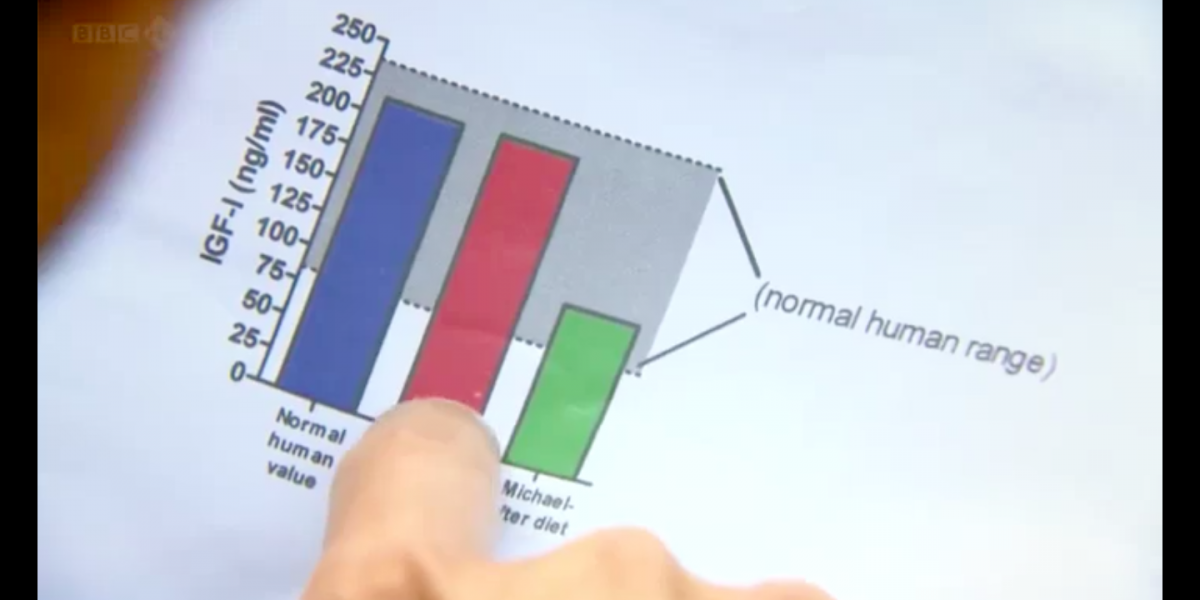
Eat, Fast, and Live Longer is well known for educating people about the 5:2 diet, where subjects can pick 2 days per week to consume just 600 calories (500 for a woman), and eat whatever they want the rest of the week.  It also covered several other strategies, which got less attention, including calorie restriction, alternate day fasting, and prolonged fasting — all of which I will cover in separate blogs.   For the section in this video on extended fasting, check out from 18:22 to 36:15, where Dr. Michael Mosley of BBC does a 3½ day fast, drinking only soup packets at night!  He gets great metabolic results!

Eat, Fast, and Live Longer

The Truth About Carbs

The other relevant BBC video I really liked was The Truth About Carbs. It is well known for popularizing the UK’s famous Low Carb Program, which is an online program that provides health tracking, education, and motivation to battle prediabetes and diabetes. The video does a good job discussing the different types of carbohydrates and how they are processed differently by the body.  You can expect 100 calories of green, leafy vegetables to be processed very differently from 100 calories of soda!

Even for non-diabetics, there’s a really interesting section of the video describing why exercisers should spit, not swallow sports drinks to get an energy boost without the calories!  Check out from 18:53 to 25:59, where Dr. Xand van Tulleken repeats the experiment during two different exercise sessions.

The truth about carbs

My take

Overall, I am a fan of these videos. The BBC isn’t funded by advertisements, so they can openly report on research that does not involve pharmaceuticals or medical devices.

At a personal level, I have tried 5:2, and I do think 5:2 works for weight loss.  Still, there are two reasons I prefer prolonged fasting for diabetes management (and reversal!)

  • I found myself obsessing about food for the 2 days when I limited myself to 600 calories.  Mentally giving myself the opportunity to eat 600 calories seemed to just open the floodgates to want to eat more.  I prefer following fewer rules and having fewer opportunities to break them.
  • Some researchers contend that 5:2 does not provide the metabolic benefits of prolonged fasting for diabetes and that even the weight loss from 5:2 is more akin to calorie restriction.

I believe that the UK’s Low Carb Program also works, and the practices remain an important complementary step to fasting and keeping insulin levels low when eating.  The reason I didn’t sign up for the digital program is that the content is very similar to that found in the classic work at the time I was diagnosed with diabetes — Dr. Bernstein’s Diabetes Solution (originally published in 1997).

To me, a big part of coping with diabetes and managing it is to be educated about what’s out there.  I’ve referred these two videos to many others because they very compactly present the research with both a journalistic and entertaining twist.

Filed Under: Diabetes, Fasting

  • « Go to Previous Page
  • Page 1
  • Interim pages omitted …
  • Page 6
  • Page 7
  • Page 8

Primary Sidebar

Recent Posts

  • Sharing the Good & Bad of Ozempic on Medium
  • Why I stopped taking Vitamin B supplements
  • What changes when you progress from chronic kidney disease stage 3B to stage 4?
  • Ozempic treats diabetes (but I didn’t lose weight!)
  • Glucose might not be the cause of Type 2 Diabetes

Archives

  • February 2025
  • December 2024
  • August 2024
  • November 2019
  • October 2019
  • June 2019
  • May 2019
  • December 2018
  • November 2018
  • September 2018
  • August 2018

Categories

  • Buchinger-Wilhelmi
  • Buchinger-Wilhelmi 2019
  • Chronic Kidney Disease
  • Diabetes
  • Fasting
  • Featured

Sign up for updates to Time-Restricted

Footer

Stephen Pao is the author of the Time-Restricted blog. Following a Type II diabetes diagnosis in 2003, Steve began experimenting with alternative approaches to managing the disease, including prolonged fasting as a complement to a low-carb lifestyle. Several years ago, Steve also added a more involved drug program, including Ozempic and Jardiance. By day, Steve is a consultant and board advisor to early stage technology companies. Steve and his wife are empty nesters, with two adult daughters.

Copyright © 2025 · Workstation Pro On Genesis Framework · WordPress · Log in